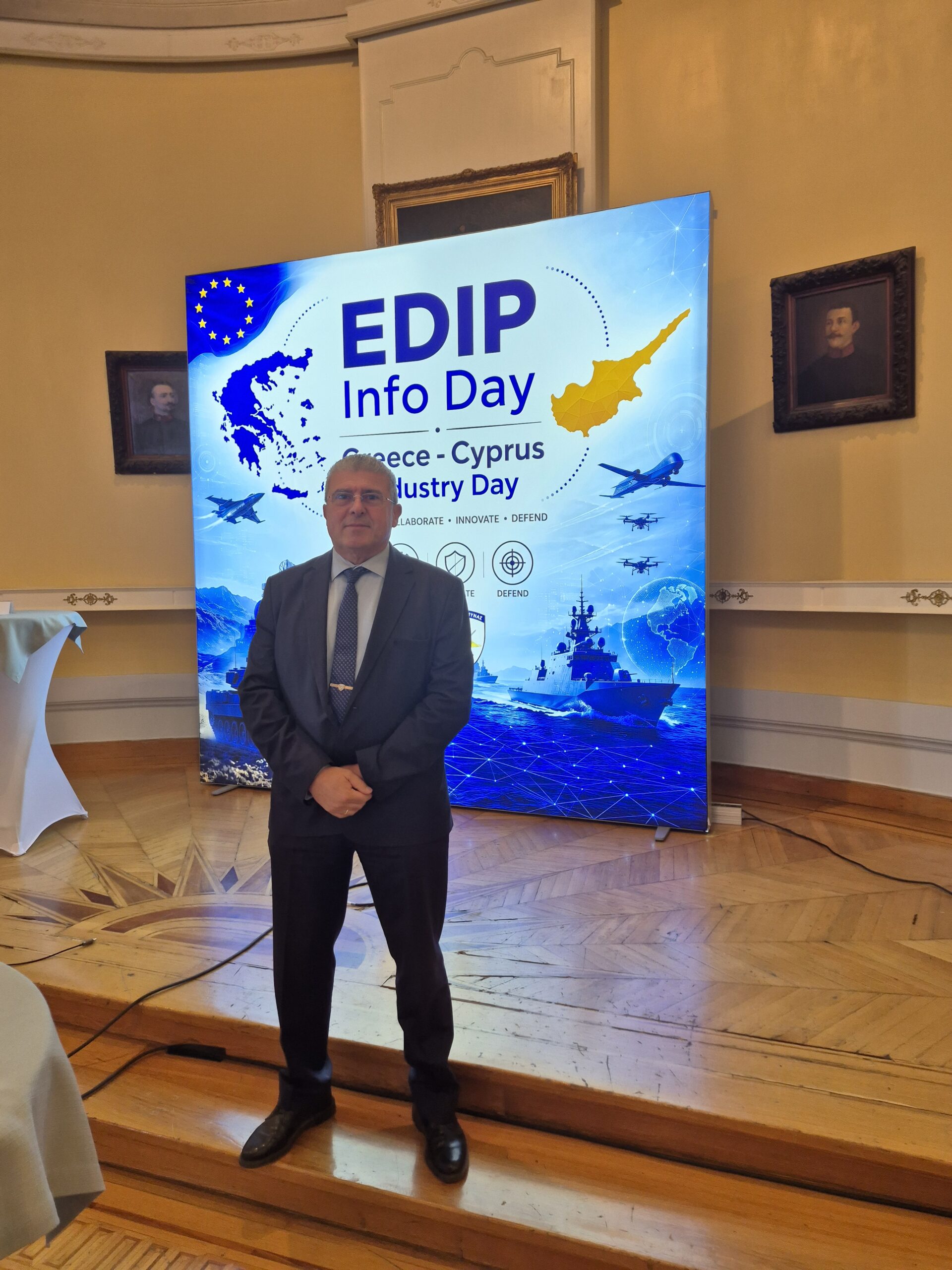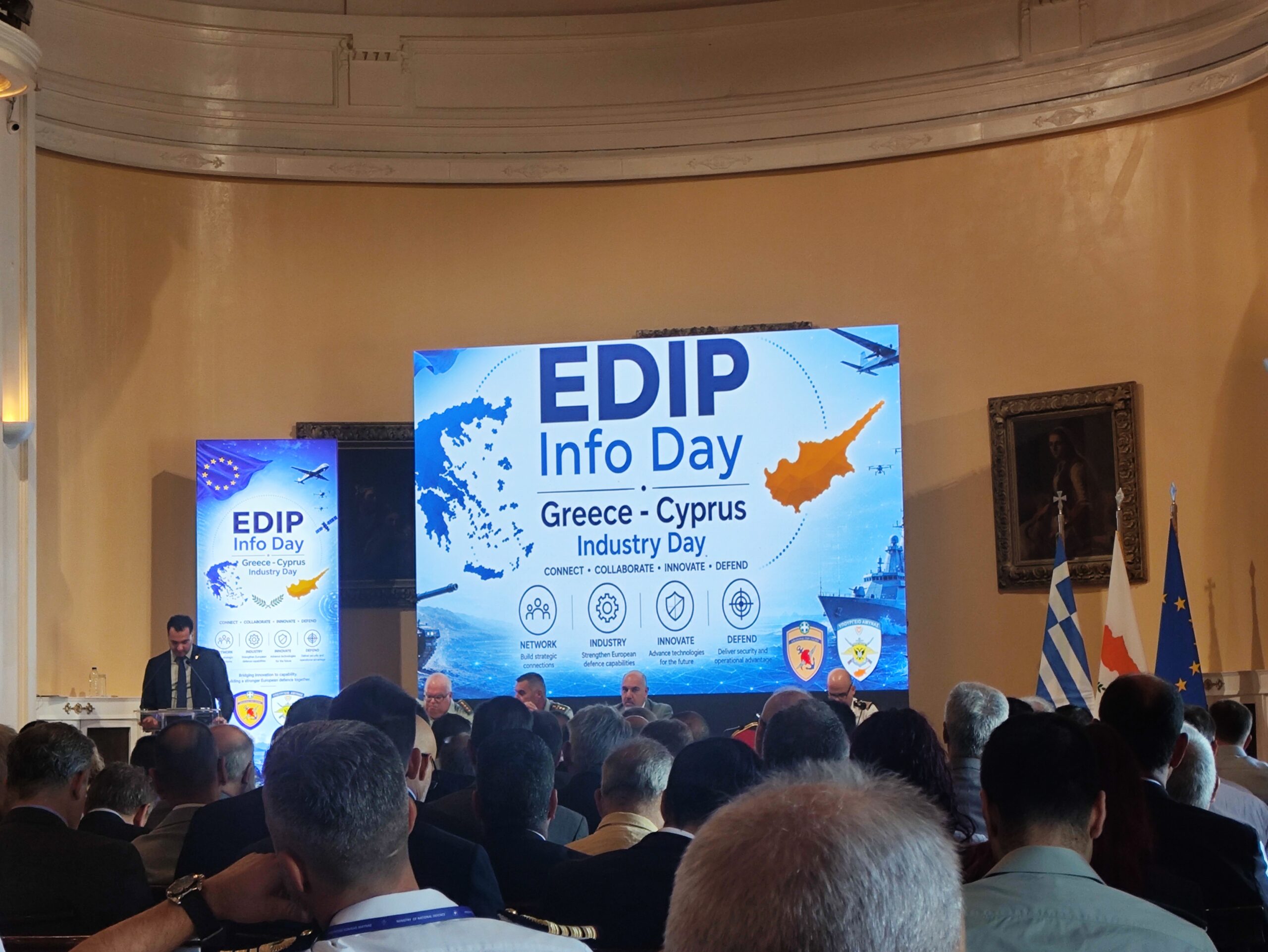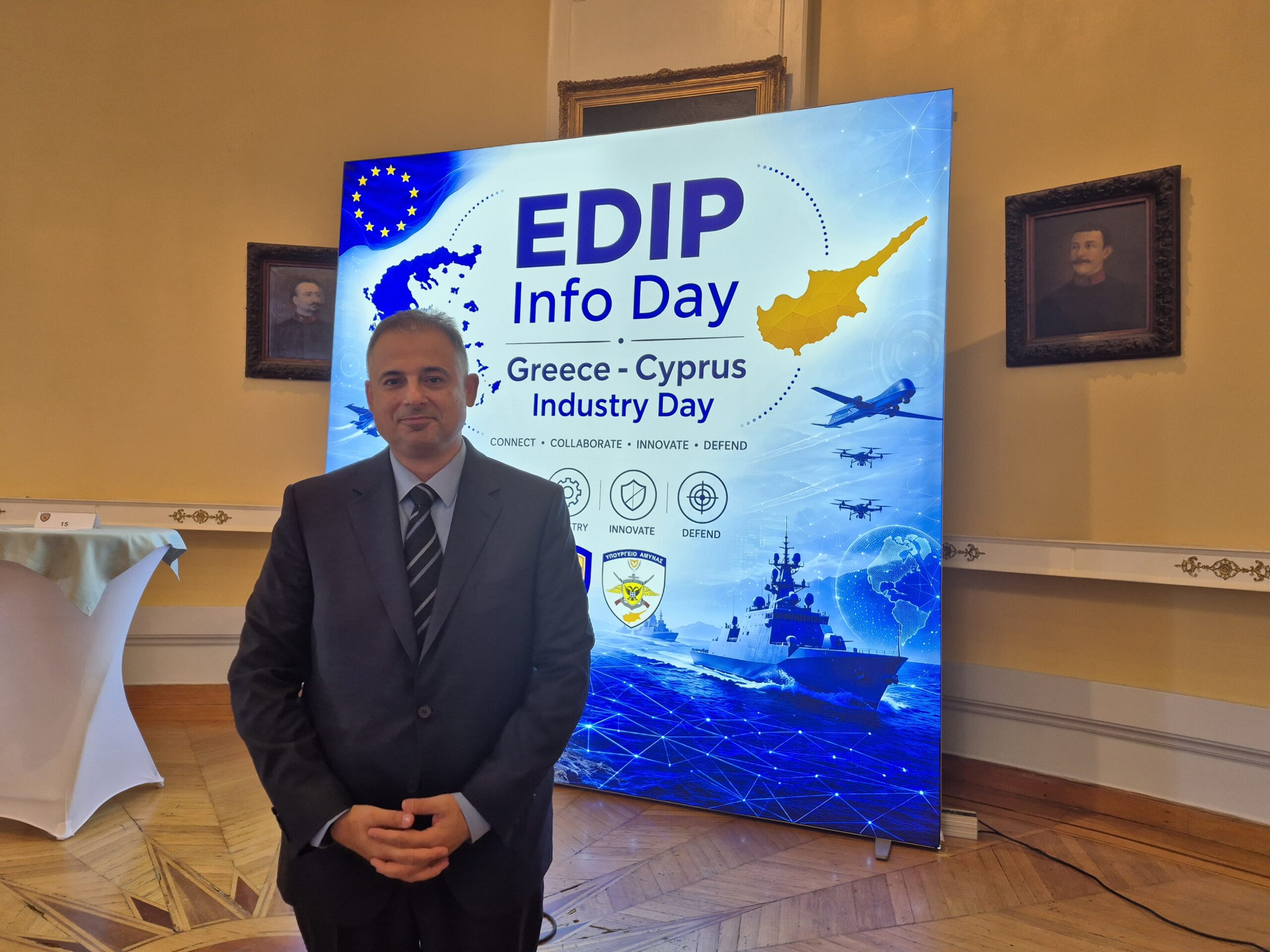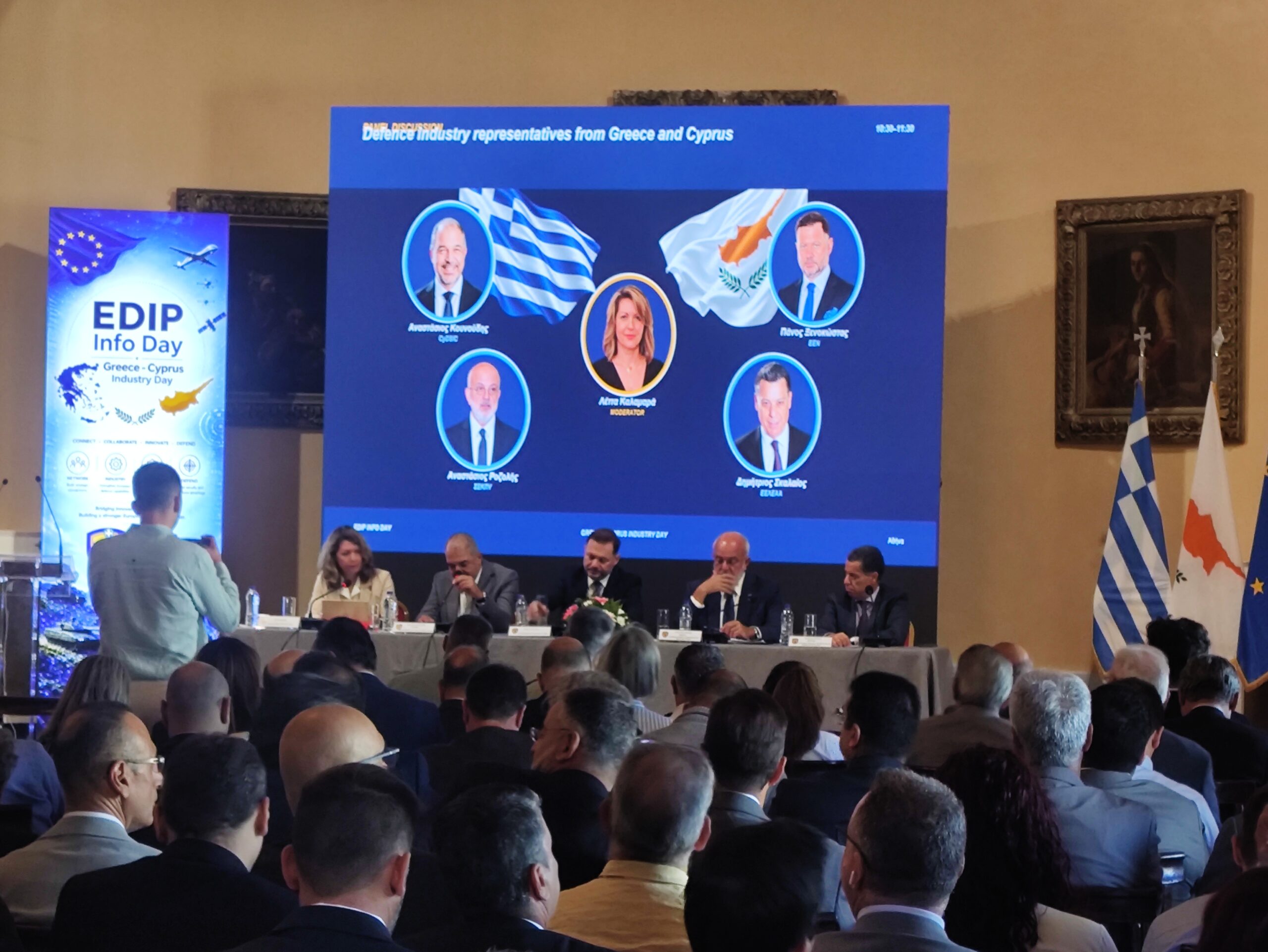
Between the funding Europe has put on the table and the orders industry is waiting for lies a gap, and it was that gap which shaped the EDIP Info Day and Greece-Cyprus Defence Industry Day held in Athens on 24 September 2026. The event took place at the Armed Forces Officers’ Club (LAED) and was organised by the General Directorate for Defence Investments and Armaments (GDDIA) of the Hellenic Ministry of National Defence together with the Ministry of Defence of Cyprus. According to the organisers’ statistics, it drew 293 registrations, 240 from Greece and 53 from Cyprus. EUDIMA attended, represented by its CEO and two colleagues.
EDIP: how the programme is built and what is open
A representative of the European Commission’s Directorate-General for Defence Industry and Space (DG DEFIS) walked the audience through the European Defence Industry Programme (EDIP), which the Council adopted in December 2025. The presentation divided the €1.5 billion budget into a €1.2 billion programme open to the EU and Norway, and a €300 million Ukraine Support Instrument. Its instruments range from industrial reinforcement actions and common procurement to supporting actions, the European Defence Projects of Common Interest (EDPCIs) and the Fund to Accelerate Defence Supply Chains’ Transformation (FAST).
Industrial reinforcement is the largest block, at about €700 million: €440 million for EU and Norwegian industry, covering energetic components, key electronic components and defence platforms and end products, and €260 million for cross-border cooperation with Ukrainian industry. The presentation set out the terms in detail. EU funding covers 35 to 50 per cent of project costs depending on the topic, and up to 100 per cent for the Ukraine-related calls. Applicants need not form a consortium. The cost of components from outside the EU and Norway may not exceed 35 per cent. The next deadlines fall on 13 October 2026 for missiles, ammunition and bombs, and on 16 February 2027 for key electronic components, platforms and end products, and unmanned and counter-unmanned systems. Common procurement adds €240 million across counter-drone, ammunition and missiles, air and missile defence, ground and naval platforms, and space-related systems, while FAST is endowed with €100 million. The programme also listed AGILE, the €115 million pilot for agile and rapid defence innovation, on which the EU institutions reached a political agreement in July, with operations expected from 1 January 2027.
The first European Defence Projects of Common Interest
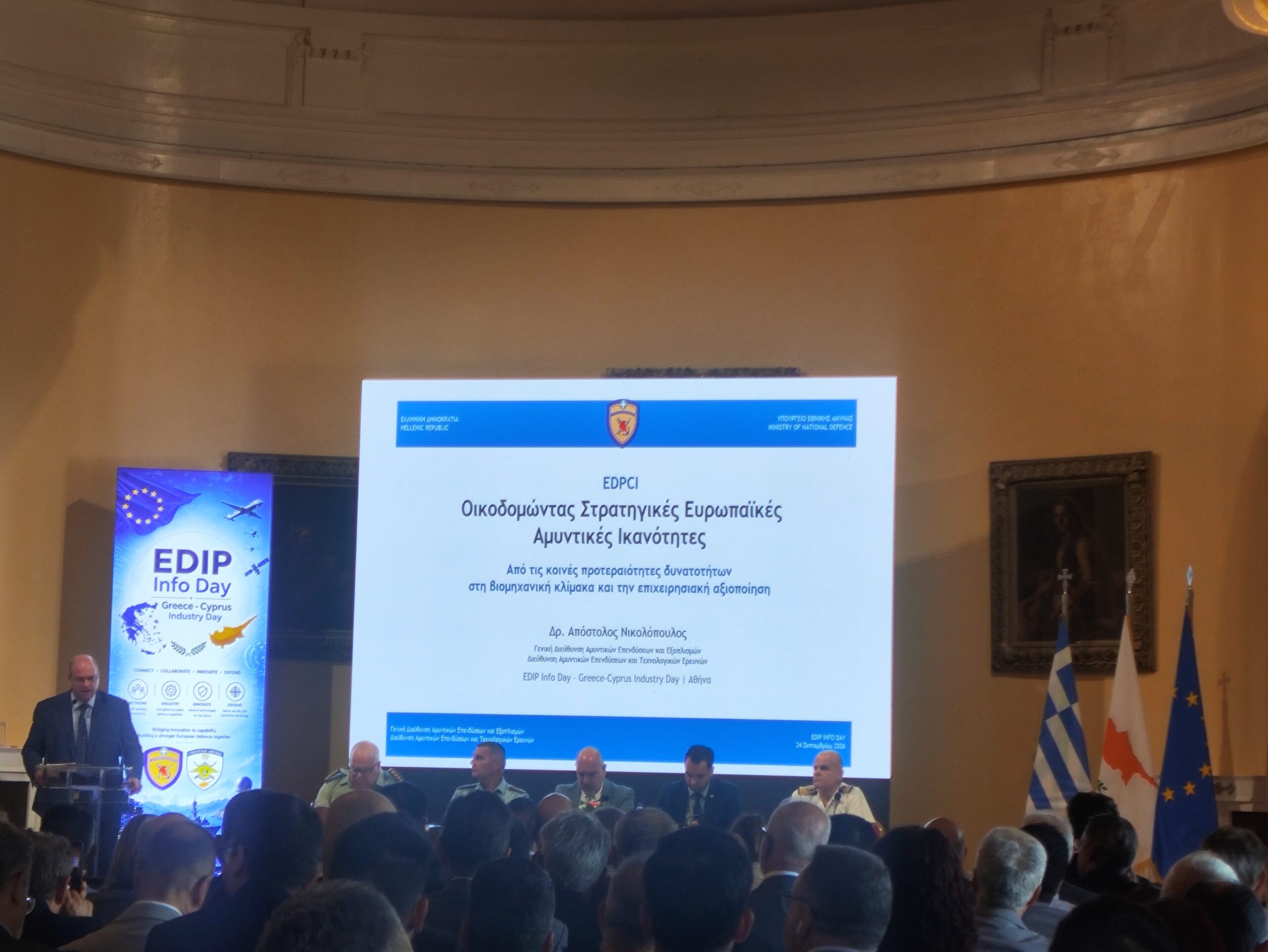
Dr Apostolos Nikolopoulos of the GDDIA’s Directorate of Defence Investment and Technological Research presented the EDPCIs as the projects that bridge the last stages of the capability development cycle, from cooperation and development towards industrial scale and operational use. He recalled the legal test in Article 35 of the EDIP Regulation, which requires at least four Member States and a demonstrable benefit for the wider Union, and the four kinds of activity the projects can support: common procurement, production capacity, industrial development and infrastructure. A distinction ran through the presentation: Member States take part in the projects, while industry delivers them through procurement, contracts and supply chains.
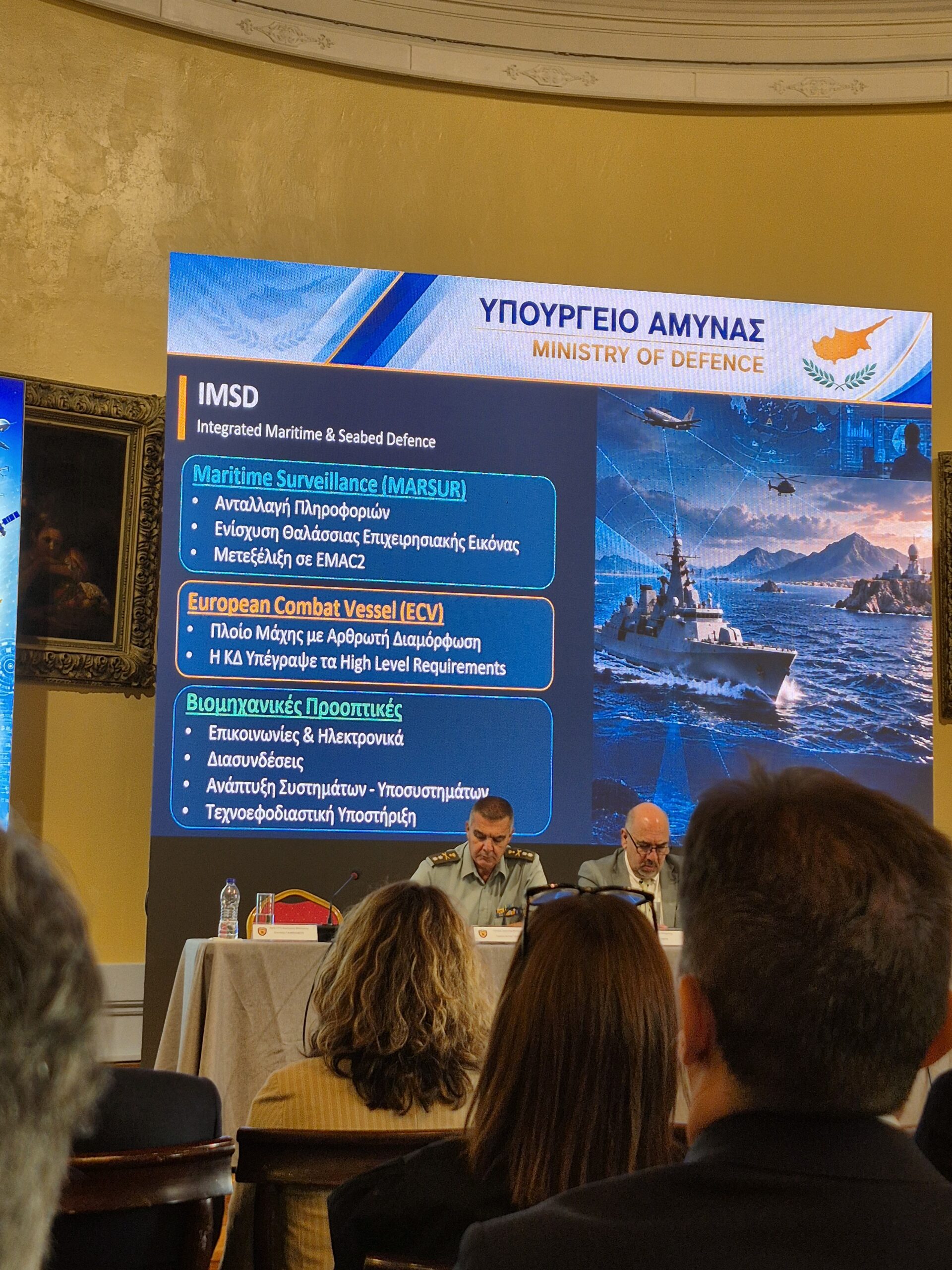
The numbers made the same point. The Commission proposed the first five EDPCIs on 3 July 2026, chosen from nine submissions, with a combined funding ambition of around €190 billion by 2036. EDIP contributes €325 million, which the presentation broke down into €300 million for deployment, €11.5 million for roadmaps and €13.5 million for maturing further proposals. It described that money as a catalyst rather than the size of the projects, with national investment, procurement and possible future EU support supplying the scale. The five projects cover drones and counter-drone systems (DECODER), integrated maritime and seabed defence (IMSD), space, air and missile defence including early warning (EU-FIAMD), and Eastern Flank Watch. According to the presentations of both ministries, Greece takes part in four of the five, all except Eastern Flank Watch, and Cyprus in all five. Four days after the meeting, on 28 September, the Council approved the five projects, making them eligible for EDIP funding.
Lieutenant Colonel Angelos Kokkinos of the Cypriot Ministry of Defence’s Directorate of Armaments and Defence Capabilities Development set out where Cyprus sees its interests. In maritime defence these include maritime surveillance and the European Combat Vessel, whose high-level requirements Cyprus has signed. In air and missile defence the emphasis is on the island’s geostrategic position. In DECODER it is common procurement of mature drone and counter-drone systems and a network of test centres, with the first pilot hubs in the Netherlands and Latvia. In space the interests are satellite communications, positioning and navigation, and the hosting of ground infrastructure. In Eastern Flank Watch, Cyprus aims to upgrade its air and naval bases, to support European and allied forces, and to establish the Eastern Mediterranean as critical to EU security. Two further proposals, ARCADIA and EDDS, on a secure digital platform and a defence data space, were described as still maturing. For each project, the presentation listed industrial openings, from electronics and software to construction, energy and logistics support.
What Greek and Cypriot industry asked for
The industry panel, moderated by Letta Kalamara, returned repeatedly to one point: research funding matters, but only if it ends in products and orders. Anastasios Rozolis, President of the Hellenic Manufacturers of Defence Materiel Association, noted that the European Defence Fund has strengthened research and that the critical step is now industrial production. He called for a clearer national picture of what Greece intends to produce domestically and for measurable criteria on domestic value added. Dimitrios Skalaios, President of the Hellenic Aerospace Security & Defense Industries Group (HASDIG), said industry expects industrialisation, mass production and orders from EDIP, and pointed to access to financing, long-term contracts and room for specialised SMEs in larger supply chains. Dr Anastasios Kounoudis, Vice-President for Policy, Institutional Affairs and Public Relations of the Cyprus Defence and Space Industry Cluster (CyDSIC), warned that long procurement cycles risk leaving a technology outdated by the time it is fielded, and argued that Greece and Cyprus should shape European developments rather than follow them.
Panos Xenokostas, President of the Hellenic Shipyards Association (HSAs), called for a binding 15-year programme of domestic naval shipbuilding with 70 per cent Greek value added. As set out in the association’s account of the speech, he asked for industrial-return indicators in the European Defence Fund and Security Action for Europe (SAFE), for funding of infrastructure such as dry docks, and for shipyards to be able to act as prime contractors, not only subcontractors.
From prototype to industrial scale: HCDI and the single register
Panagiotis Papageorgiou, Executive Board Member of the Hellenic Centre for Defence Innovation (HCDI), presented the path from idea to operational adoption, with technology and manufacturing readiness levels advancing in parallel. HCDI’s role in EDIP, as outlined, covers early identification of European opportunities, mapping Greek technologies and companies, and preparing SMEs and start-ups to form consortia. Field testing was the centrepiece. In one 2026 request for information, 25 entities at technology readiness level 7 or above were evaluated and 11 were selected for tests of unmanned and counter-unmanned systems in real conditions. The presentation also outlined how NATO’s DIANA programme offers contract funding and access to more than 200 test centres.
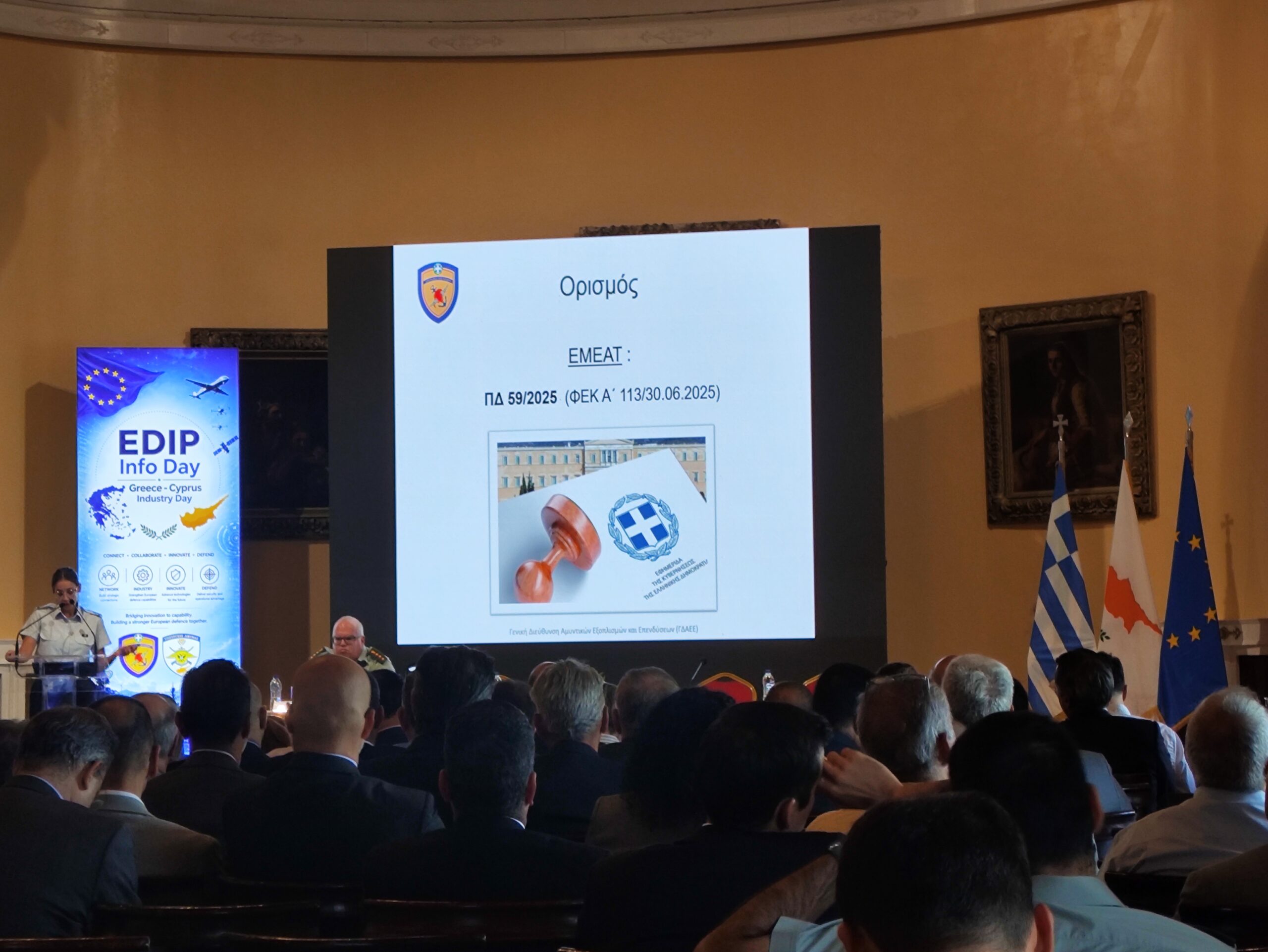
Second Lieutenant Thomais Mandilari of the GDDIA presented the Single Register of Defence Sector Enterprises (EMEAT), established by Presidential Decree 59/2025. Registration is valid for five years and, according to the presentation, opens the way to tenders under the national defence procurement law from 31 December 2026, to NATO Declarations of Eligibility and to export licences. It listed 56 registered companies. The main assessment points were documented activity, alignment with the EU Common Military List and clarity of the requested category.
The next EU budget: readiness decides
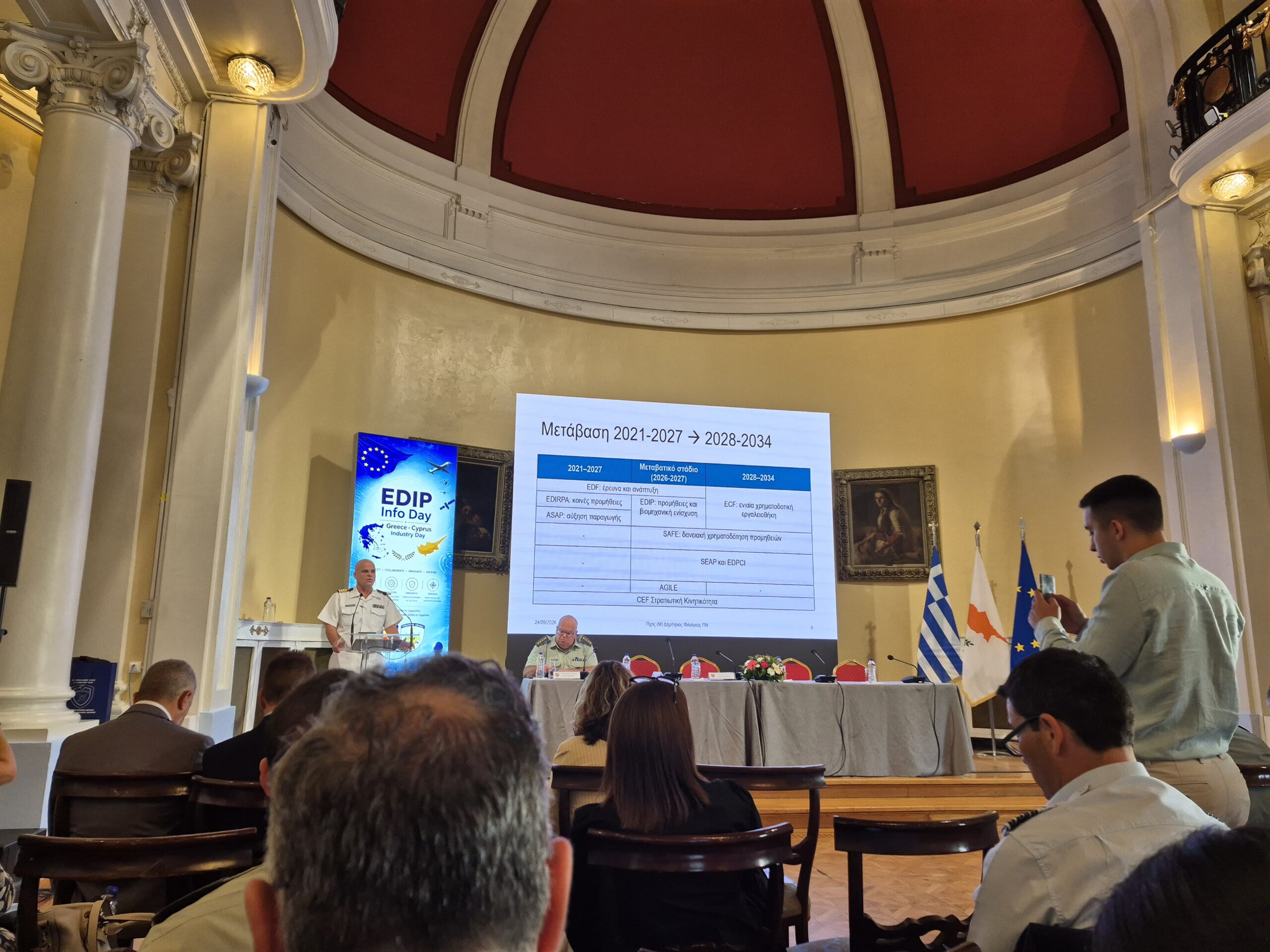
Captain Dimitrios Filiagkos of the Hellenic Navy, Director of the GDDIA’s Directorate of Defence Investment and Technological Research, turned to the 2028 to 2034 Multiannual Financial Framework (MFF), which he noted is still under negotiation and expected to be adopted around the end of 2027. In the Commission’s proposal, the defence and space window of the European Competitiveness Fund would receive €131 billion, and military mobility under the Connecting Europe Facility would grow tenfold. The presentation distinguished two routes. Pillar I, through national and regional partnership plans, requires national preparation, with a pool of mature projects and a plan to be submitted to the Commission in the second quarter of 2027. Pillar II, through the Competitiveness Fund and the Connecting Europe Facility, requires European partnerships and thematic proposals promoted to other Member States and the Commission from the fourth quarter of 2026. It also outlined indicative co-financing patterns for each type of action. His shorthand for both was that whoever is ready wins.
Greece and Cyprus: shared systems, joint proposals
Because the two countries operate common systems, several speakers saw scope for shared operational needs and joint offers to third markets. Business-to-business meetings between Greek and Cypriot companies and organisations took place in the afternoon. The organisers’ statistics point to where attention lay: EDIP and the EDPCIs were the topic most often selected by registrants, followed by the next MFF and the Competitiveness Fund.
EUDIMA’s perspective
For EUDIMA, the day confirmed how quickly the European funding landscape is layering. EDIP, the EDPCIs, AGILE, SAFE and the European Defence Fund each address a different stage between research and delivery, and the next MFF is set to consolidate much of this under the European Competitiveness Fund. Knowing how these instruments connect, and when each becomes relevant, is central to advising on strategy and EU and NATO funding. The Athens discussions also underlined that industrial readiness, credible partnerships and the ability to scale are becoming as decisive as technological quality, particularly for SMEs and mid-caps.
Funding as a starting point
The recurring message from Athens was that funding is only the starting point, the real measure is whether it produces capacity, partnerships and orders. The coming months will test that, with EDIP calls closing in October 2026 and February 2027, AGILE due to start in January 2027, and the MFF negotiations continuing. EUDIMA thanks the Hellenic Ministry of National Defence, the GDDIA and the Ministry of Defence of Cyprus for a timely and substantive event.