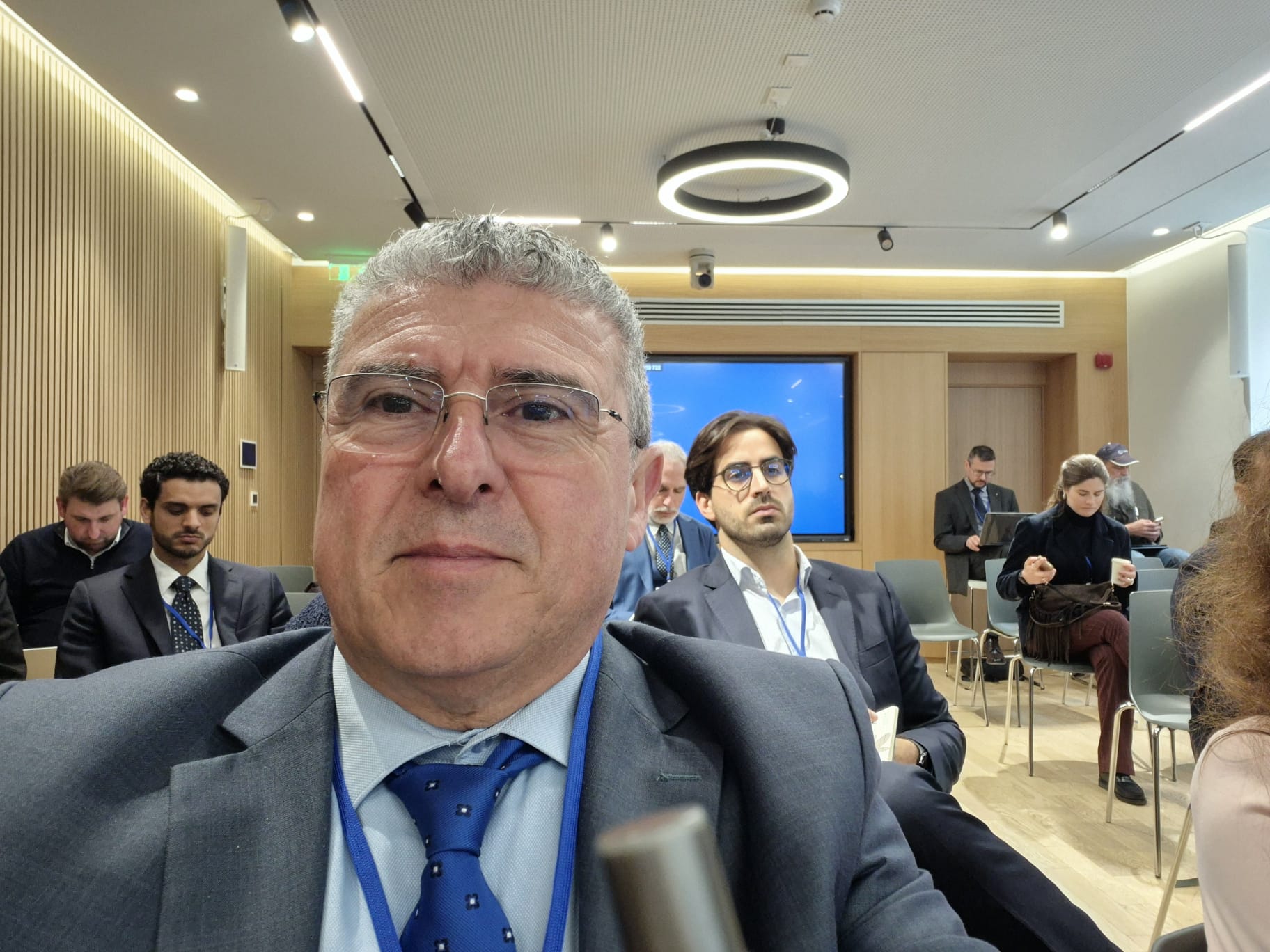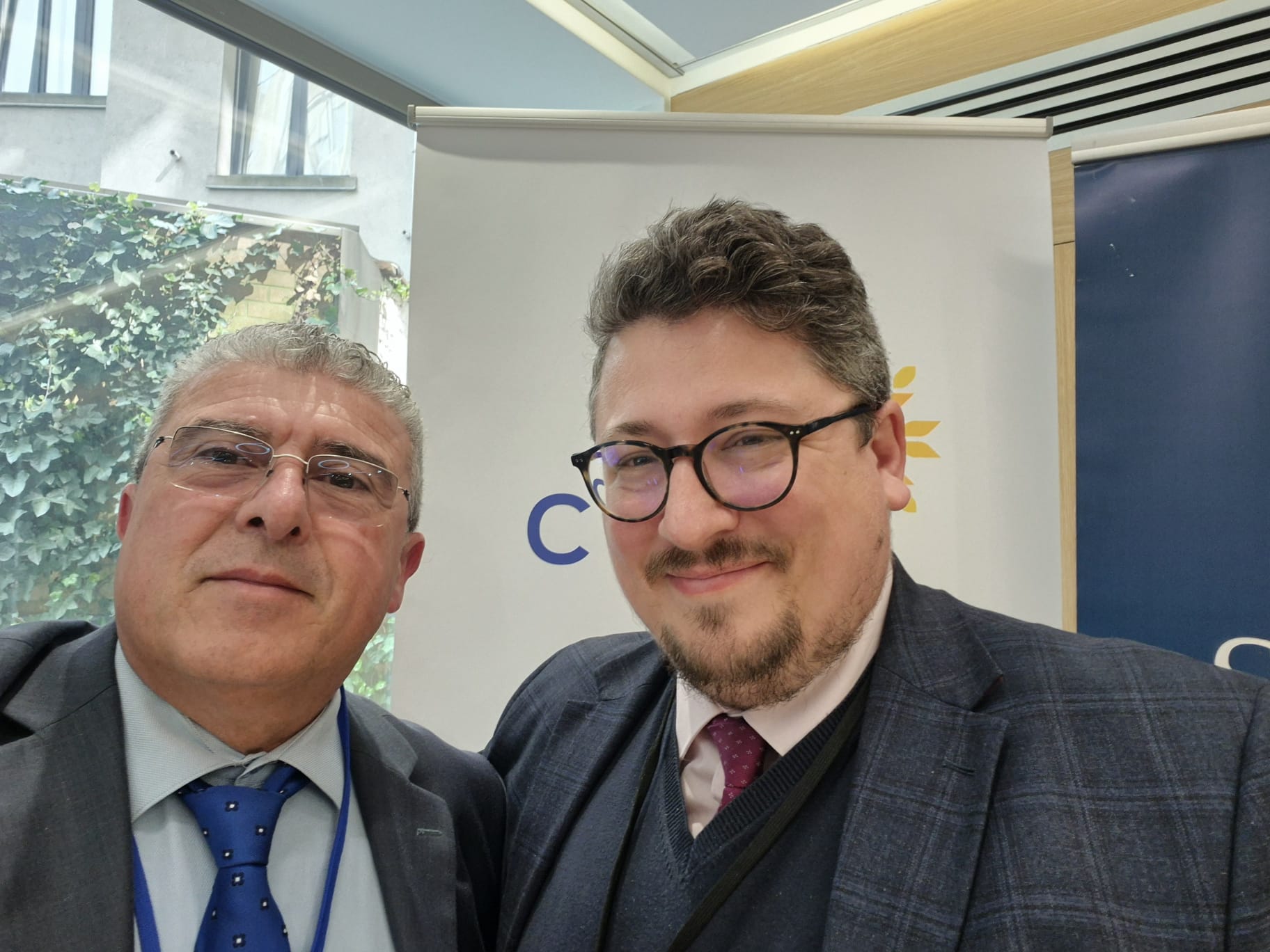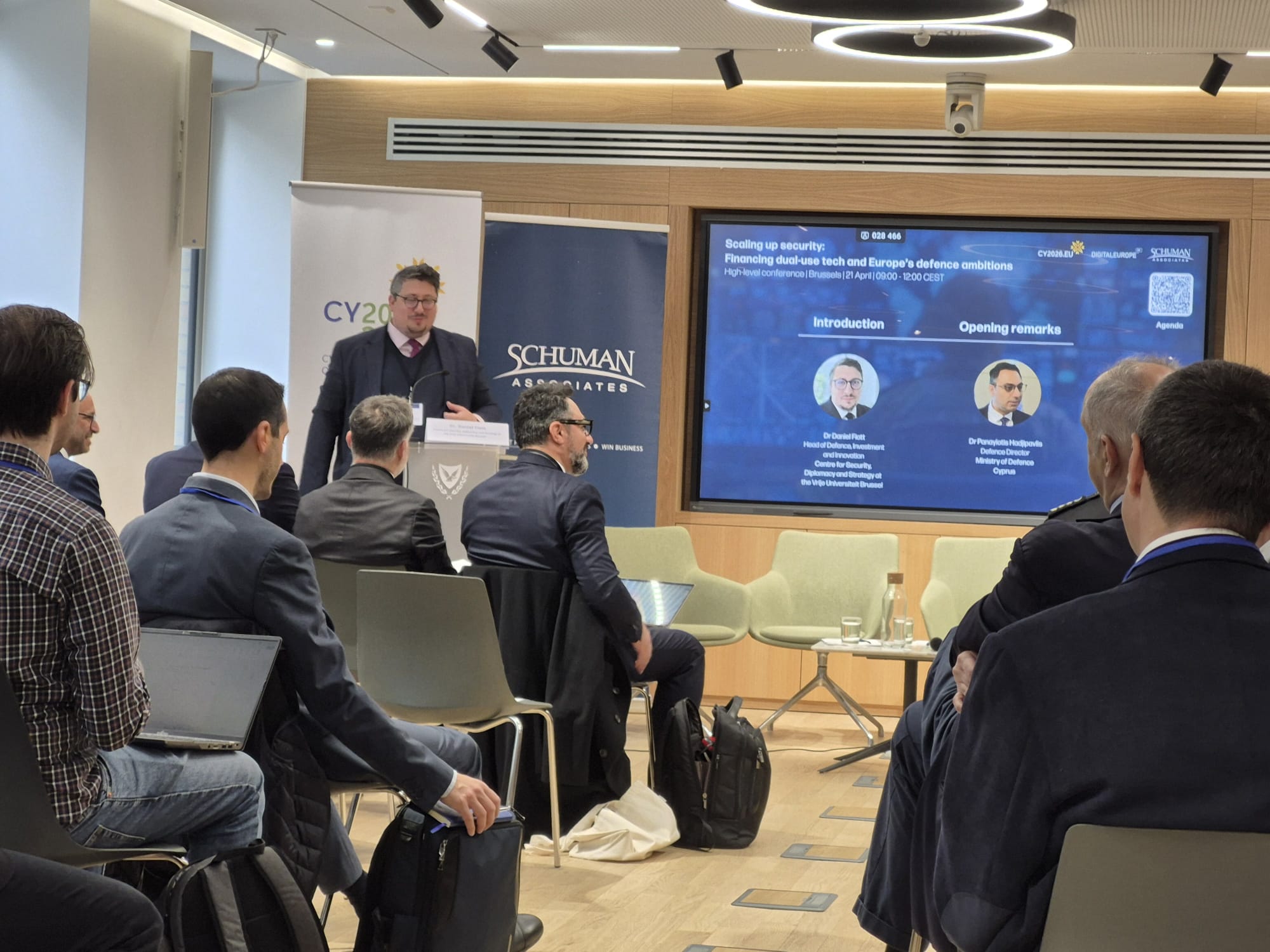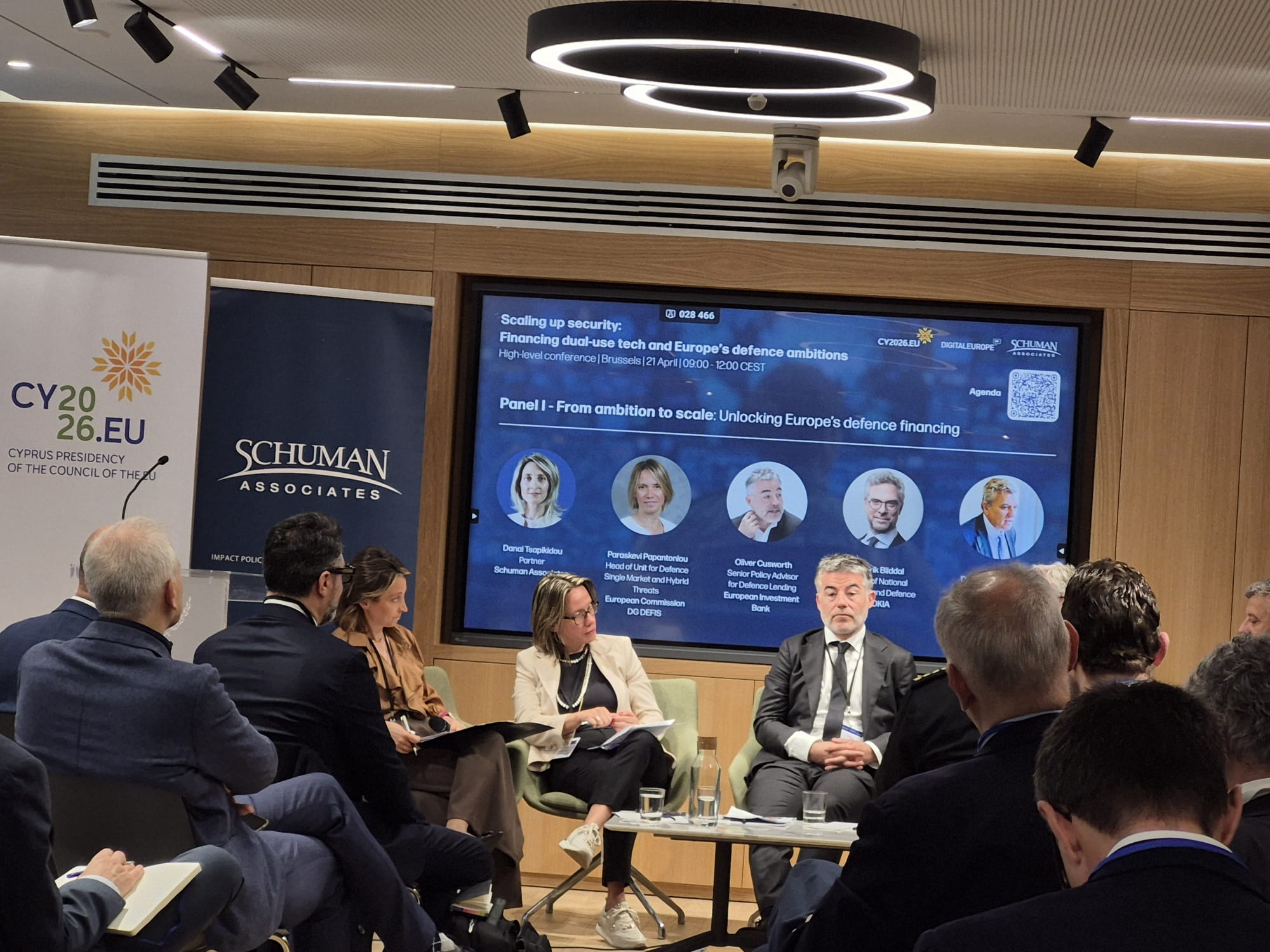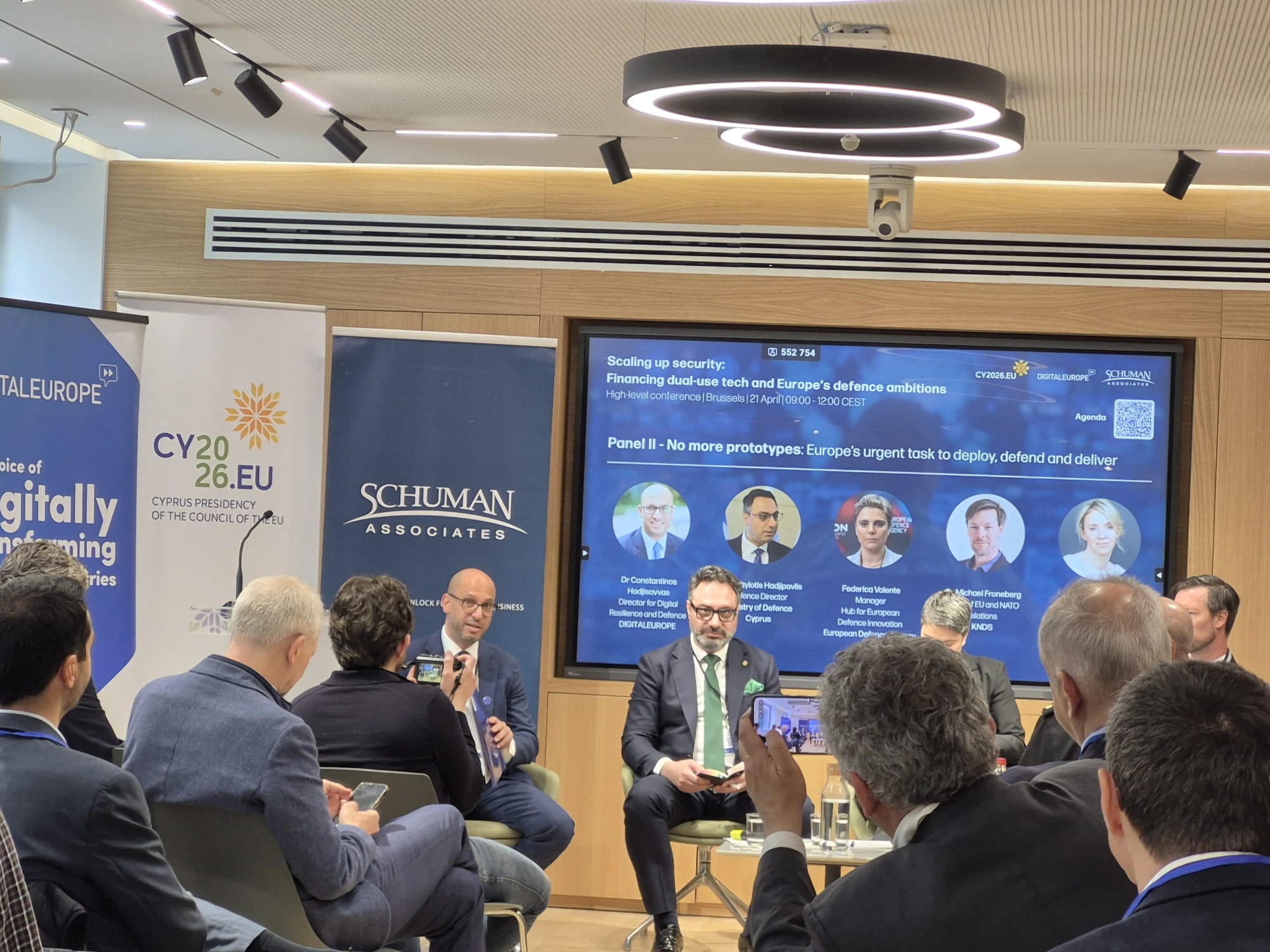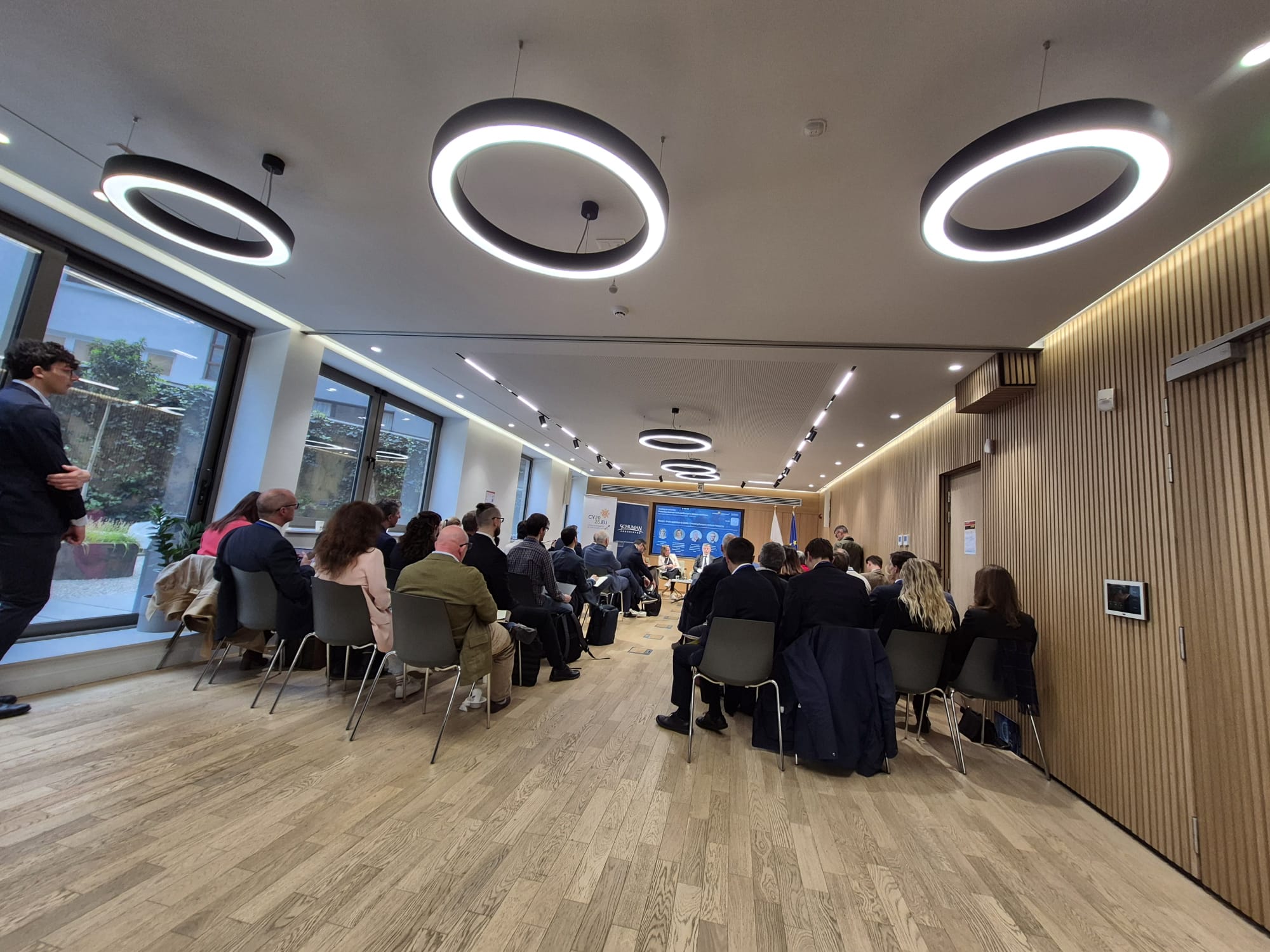
Europe has entered a decisive phase in how it finances, scales, and deploys the technologies on which its defence readiness now depends. This was the central question at Scaling up Security: Financing Dual-use Tech and Europe’s Defence Ambitions, a high-level conference held on 21 April 2026 at the Permanent Representation of the Republic of Cyprus to the EU in Brussels. Organised by DIGITALEUROPE and Schuman Associates under the auspices of the Cyprus Presidency of the Council of the EU, with the support of the Cyprus Ministry of Defence, the half-day event convened more than one hundred representatives from defence, technology, finance, and policy. EUDIMA attended, represented by its CEO.
A high-level conference under the Cyprus Presidency
The conference took place at a moment when political ambition and financial commitments for European defence stand at historic highs, but the translation of those commitments into funded projects and capabilities in service has become the defining challenge. Under the motto “An Autonomous Union. Open to the World.”, the Cyprus Presidency has placed Autonomy through Security, Defence Readiness and Preparedness at the top of its agenda, committing to drive forward the White Paper on the Future of European Defence and the Readiness Roadmap 2030, alongside the rollout of the Security Action for Europe (SAFE) instrument and the recently adopted European Defence Industry Programme (EDIP). The choice of venue underlined the Presidency’s direct stewardship of the discussion.
The proceedings were introduced by Dr. Daniel Fiott, Head of Defence, Investment and Innovation at the Centre for Security, Diplomacy and Strategy (CSDS) at the Vrije Universiteit Brussel, who served as scene-setter and moderator throughout the day. Opening remarks were delivered by Dr. Panayiotis Hadjipavlis, Defence Director at the Cyprus Ministry of Defence, who highlighted the importance of accelerating the transition from innovation to the deployment of operational capabilities and of strengthening European defence readiness. His intervention set the tone for the debate that followed: closing the gap between European ambition and European delivery requires a financial architecture, a procurement culture, and an industrial base that work together rather than in isolation.
From ambition to scale: unlocking Europe’s defence financing
The first panel, titled “From ambition to scale: unlocking Europe’s defence financing”, was moderated by Danai Tsapikidou, Partner at Schuman Associates, and examined how current and future EU tools can better support defence and dual-use technologies and create conditions for growth across Europe’s industrial base, particularly for small and medium-sized enterprises (SMEs). The panel brought together Paraskevi Papantoniou, Head of Unit for Defence Single Market and Hybrid Threats at the European Commission’s DG DEFIS; Oliver Cusworth, Senior Policy Advisor for Defence Lending at the European Investment Bank (EIB); Henrik Bliddal, Head of National Security and Defence at Nokia; and David Luengo, Managing Director of the Brussels Office of Indra Group.
A central theme emerging from the discussion was that Europe has built a substantially broader defence and dual-use toolbox, from EU programmes such as EDF, EDIP, and SAFE to expanded EIB Group instruments and new scale-up vehicles. Yet the multiplication of instruments has not resolved the more fundamental problem of system coherence: funding, financing, procurement, and industrial planning still do not connect tightly enough to generate predictable pathways from investment to deployment. The question confronting participants was therefore not whether the right mechanisms exist on paper, but whether they operate in a sufficiently joined-up way to create capability at the pace and scale that Readiness 2030 demands.
Reflecting on the discussion, Luengo underlined that the European defence and security industry carries a crucial responsibility towards the armed forces of EU Member States at a moment when financial capacity within the EU system is substantial and the real challenge is delivery at scale and speed. He argued that managing risks, rather than avoiding them, is an essential component of business growth and innovation, and that the sector must prepare for disruption rather than assume future stability.
No more prototypes: Europe’s urgent task to deploy, defend, and deliver
The second panel, titled “No more prototypes: Europe’s urgent task to deploy, defend, and deliver”, was moderated by Dr. Constantinos Hadjisavvas, Director for Digital Resilience and Defence at DIGITALEUROPE. Speakers included Dr. Panayiotis Hadjipavlis; Federica Valente, Manager of the Hub for European Defence Innovation (HEDI) at the European Defence Agency (EDA); Dr. Michael Froneberg, Head of EU and NATO Relations at KNDS; and Kadi Silde, Director for European Engagement at Helsing. The panel addressed the structural gap that persists between a successful prototype and a fielded, scalable capability, one of the weakest parts of the current European defence ecosystem.
The discussion made clear that procurement, not innovation finance, has become the critical bottleneck in the innovation-to-deployment chain. Support for research, pilots, and early-stage development has improved considerably, but too many technologies with proven promise still face slow, fragmented, and uncertain procurement pathways. For digital and software-driven capabilities in particular, long acquisition cycles carry an especially acute cost: they risk making solutions operationally outdated before they ever reach deployment. The challenge, as framed by the panel, is not only to move faster, but to connect procurement more effectively with end-user needs, testing, and operational validation. Fragmentation compounds this problem: divergent national requirements, separate procurement timelines, and customised variants do not merely reduce efficiency, they are becoming a strategic liability that limits interoperability and undermines the industrial and operational mass Europe needs.
No time to wait: finance it, deploy it, defend Europe
The closing high-level policy conversation, titled “No time to wait: finance it, deploy it, defend Europe”, was again moderated by Dr. Daniel Fiott, Head of Defence, Investment and Innovation at the Centre for Security, Diplomacy and Strategy (CSDS) at the Vrije Universiteit Brussel, and brought together Cecilia Bonefeld-Dahl, Director-General of DIGITALEUROPE; Merete Clausen, Deputy Chief Executive of the European Investment Fund; and Dr. Tomasz Husak, Director of Defence Policy at the European Commission’s DG DEFIS. The exchange focused on how Europe’s defence ambitions can be matched with speed and scale, and what needs to change to turn commitments into deployable capabilities under the next Multiannual Financial Framework 2028–2034.
The discussion underscored that the next MFF will matter not simply because it may bring more funding, but because of whether it creates a more coherent link between capability priorities, procurement pathways, and industrial scale-up. Financing tools will need to support the full path from development to production, including blended finance, lending, equity, and risk-sharing mechanisms that can help SMEs and scale-ups grow. A shift from risk aversion to managed risk was identified as essential, particularly for digital and dual-use technologies that depend on shorter update cycles, iterative acquisition, and faster integration into operational use.
Closing the conference, Colonel Constantinos Constantinou, Military Representative of the Republic of Cyprus to the EU Military Committee, and Ruth Estrada Dorronsoro, CEO of Schuman Associates, emphasised the need to achieve tangible results and to reinforce European operational readiness through faster capability development and deployment. Their remarks gave concrete expression to the event’s central argument: credibility in European defence will depend increasingly on the ability to move faster in procurement, faster in industrial scaling, and faster in connecting innovation to end use.
EUDIMA at the heart of the discussion
For EUDIMA, the conference provided an exceptional vantage point on the debate now shaping Europe’s defence financing architecture. Attending in person, the CEO engaged directly with a wide cross-section of stakeholders and participants, from EU institutions and national authorities to financial institutions, industry leaders, and innovators. These exchanges reinforced the firm’s reading of the strategic environment: the next eighteen months will determine whether the current generation of EU defence instruments, from SAFE and EDIP to EIB defence lending and the forthcoming MFF 2028–2034, can be combined into a financing pathway that SMEs, scale-ups, and established primes alike can actually use. This insight feeds directly into EUDIMA’s advisory work in EU and NATO defence funding, consortium building, and alignment with European capability priorities.
Europe’s defence ambitions will be measured not by the scale of its commitments, but by the speed and scale of their delivery. The Cyprus Presidency has placed that test at the centre of its agenda, and conferences such as this one are where finance, procurement, industry, and capability are brought into the same room and asked to cohere. EUDIMA thanks DIGITALEUROPE, Schuman Associates, the Cyprus Presidency, and the Cyprus Ministry of Defence for a timely and substantive discussion.